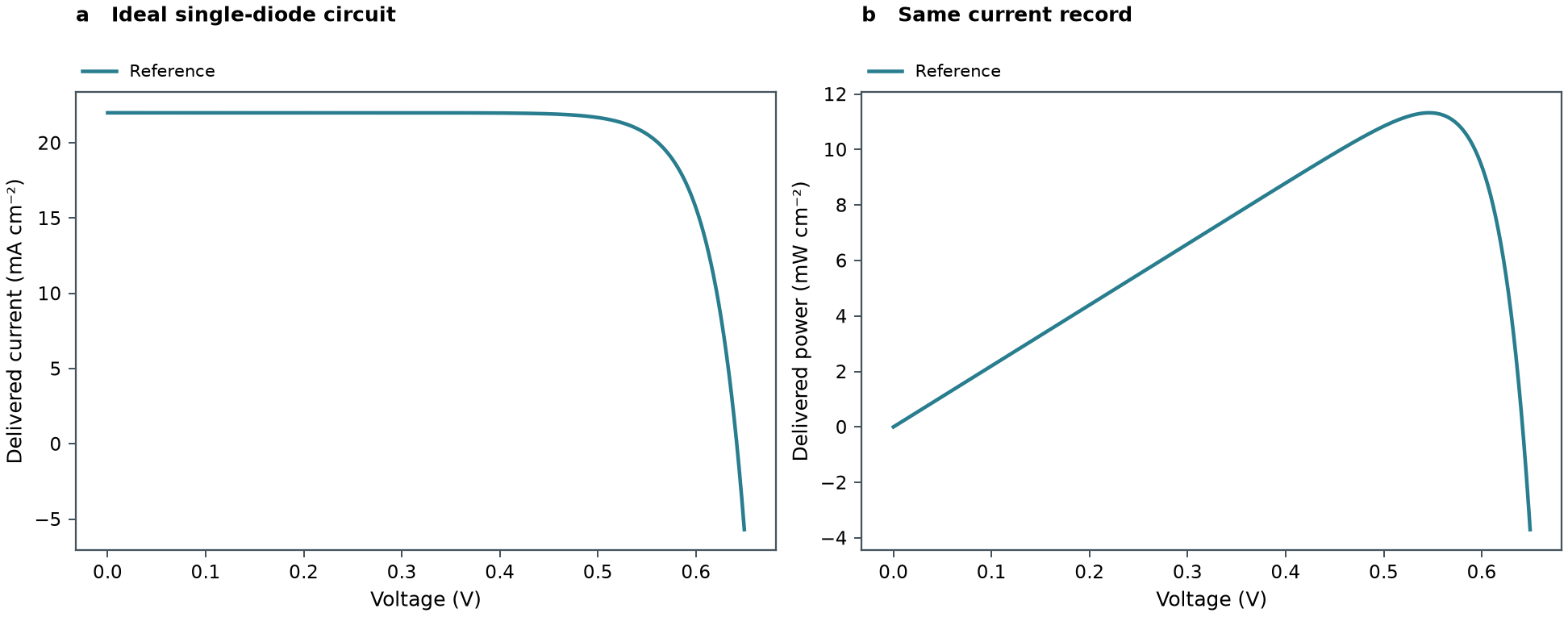
理想光伏 J–V 与功率
论文图型参考 · 原创模型演示。
合成示例 · 非实验数据
 放大图样 ↗
① 源码与 CSV 解压到同一文件夹。
② 请 AI 运行 render_existing.py,得到 PNG、SVG 和 PDF;再核对并换成你的数据。
源码和 CSV 解压到同一文件夹即可重画。图件和提示词可分别下载。
你也可以用自己的话说。
查看请求
请读取绘图包里的 README 和 metadata.json,按说明在项目独立环境中运行包内已有源码,重画这份演示数据。不要重新生成或改写演示 CSV。收到我的文件后,先核对列名、单位、归一化基准与测试条件,再在副本中适配。逐圈容量、库伦效率与容量保持率用散点,不加连线;连续电压和光谱用无点实线,数据坐标四周保留框线。全电池保持率需明确参考圈、参考容量和相同工况,缺项先补齐;Li‖Cu 不强加保持率。不要继承演示条件、补造数据或静默覆盖旧图;回复只给结果位置和必要的下一步。
论文依据、公式与适用范围
原创模型演示,不复现论文数据;图型参考与公式依据分别注明。
Figure 1a; Equation 1 and its limitations
J=JL−J0[exp((V+JRs)/(n kBT/q))−1]−(V+JRs)/Rsh; J in A/cm²
P=VJ; FF=Pmax/(Voc*Jsc); PCE=Pmax/Pin
J0(T)=J0ref*(T/Tref)^3*exp[−Eg/kB*(1/T−1/Tref)]
The reference explicitly warns against Shockley fitting of low-mobility organic photovoltaics. These examples only teach an ideal circuit; they are NOT an organic device transport model, certified efficiency, AM1.5 spectral simulation or material-specific prediction.
输入与使用边界
data.csv, model.json
输入格式、单位和条件见 README 与 metadata.json。示例是合成数据,不能用于论文实验结果。
Declared analytic parameters in scientific_basis.parameters; no experimental cell or material is assigned.
示例的模型与依据
按声明的教学模型生成。参数为自设,引用支持公式或测试方法,不是从论文复制的实测数字。
计算关系
- J=JL−J0[exp((V+JRs)/(n kBT/q))−1]−(V+JRs)/Rsh; J in A/cm²
- P=VJ; FF=Pmax/(Voc*Jsc); PCE=Pmax/Pin
- J0(T)=J0ref*(T/Tref)^3*exp[−Eg/kB*(1/T−1/Tref)]
使用边界
- The reference explicitly warns against Shockley fitting of low-mobility organic photovoltaics. These examples only teach an ideal circuit; they are NOT an organic device transport model, certified efficiency, AM1.5 spectral simulation or material-specific prediction.
模型来源
- Impact of charge transport on current–voltage characteristics and power-conversion efficiency of organic solar cells
J–V / power reporting form. Our ideal diode is explicitly NOT a fit or a transport model for organic devices.
相关资源
来源与引用
原创合成示例,数据与本版源码包含在绘图包内;未使用论文数据或原图
VoltPeer. 理想光伏 J–V 与功率. Synthetic teaching delivery, version 1.0.0; data generator 1.0.0.BIB ↓ RIS ↓
VoltPeer maintainers · v1.0.0 · MIT
文件、校验与检查状态
文件和格式已检查;模型测试范围见适配说明。格式检查不代表科学审核。
assets/showcase/paper_pv_jv/data.csv  b3342e04c14dde8eaa20079d0b39c3253c568f7ebb5bebe0d4d434653fd75d45
assets/showcase/paper_pv_jv/figure.pdf  4a5dace0c6bad075176e4ceda3107222155d7af1e495893ba4449f1706e27cbc
assets/showcase/paper_pv_jv/figure.png  c745924876da3a04a988515886b582908df79709cc6a3fd04517a6062c9d6d26
assets/showcase/paper_pv_jv/figure.svg  13d0c5ea3b225b4da15ebc487eeca068c1f2210379d6e4353bf3b45835bdb8b7
assets/showcase/paper_pv_jv/metadata.json  6d706dd63fed064fff1e4e2f427990dd35566a2c8698a2a3f1946c58ae8a008c
assets/showcase/paper_pv_jv/model.json  0c802d39abed2ca538267425328661072e586c45200f1ff9da68854d8bdc5162
assets/showcase/paper_pv_jv/render-report.json  35540834e5c8031f297229864886afebc398463c8418510f382a14248e4b92ee
assets/showcase/BRF-demo-paper_pv_jv.zip  e263eda07418ec88bbb42926f0fd001a104082f5af76f11a17dd12e9df3f83b6
assets/citations/paper_pv_jv.bib  be6db23cd840e5548eab1067de9b346ffcd3a48c538ef1be41b4f2390190f925
assets/citations/paper_pv_jv.ris  25be209a6750cdfedcc092f1c1625479927cfc0b32c163972f620045cd9630d2