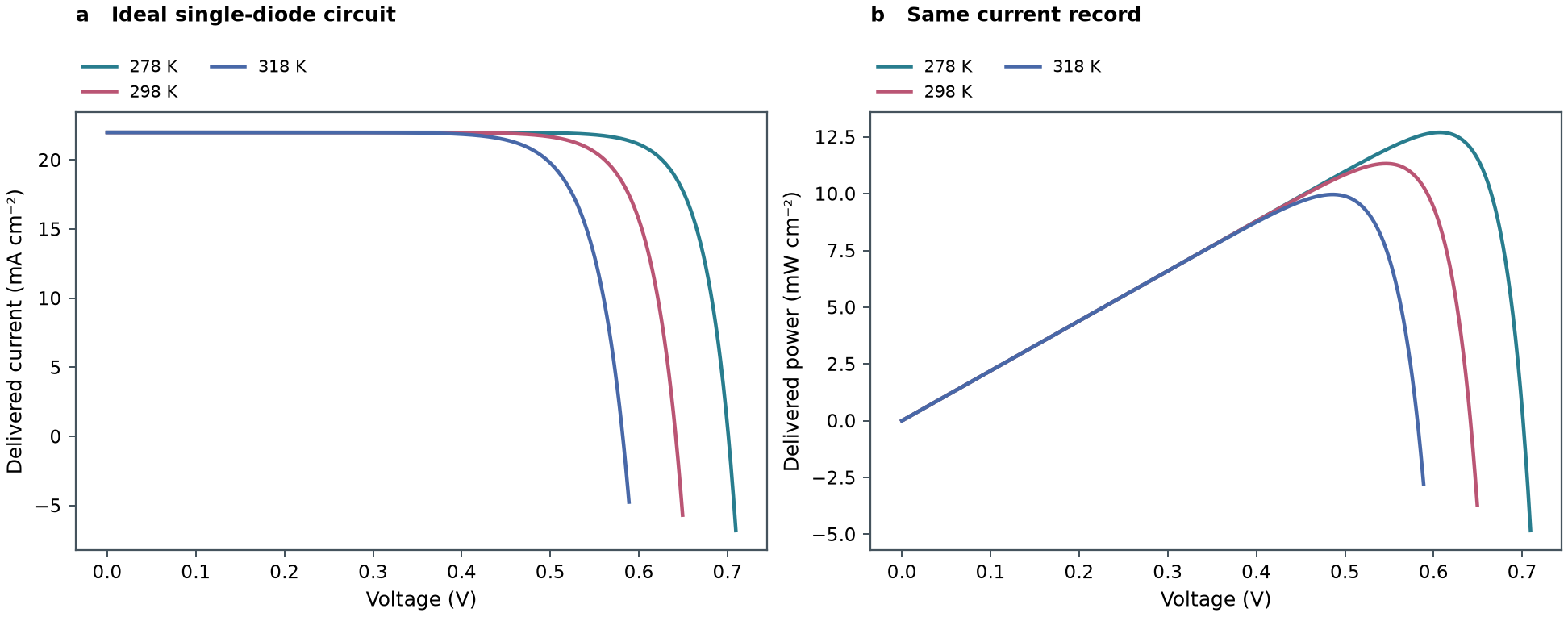
理想二极管的温度响应
论文图型参考 · 原创模型演示。
合成示例 · 非实验数据
 放大图样 ↗
① 源码与 CSV 解压到同一文件夹。
② 请 AI 运行 render_existing.py,得到 PNG、SVG 和 PDF;再核对并换成你的数据。
源码和 CSV 解压到同一文件夹即可重画。图件和提示词可分别下载。
你也可以用自己的话说。
查看请求
请读取绘图包里的 README 和 metadata.json,按说明在项目独立环境中运行包内已有源码,重画这份演示数据。不要重新生成或改写演示 CSV。收到我的文件后,先核对列名、单位、归一化基准与测试条件,再在副本中适配。逐圈容量、库伦效率与容量保持率用散点,不加连线;连续电压和光谱用无点实线,数据坐标四周保留框线。全电池保持率需明确参考圈、参考容量和相同工况,缺项先补齐;Li‖Cu 不强加保持率。不要继承演示条件、补造数据或静默覆盖旧图;回复只给结果位置和必要的下一步。
论文依据、公式与适用范围
原创模型演示,不复现论文数据;图型参考与公式依据分别注明。
Figure 1a; Equation 1 and its limitations
J=JL−J0[exp((V+JRs)/(n kBT/q))−1]−(V+JRs)/Rsh; J in A/cm²
P=VJ; FF=Pmax/(Voc*Jsc); PCE=Pmax/Pin
J0(T)=J0ref*(T/Tref)^3*exp[−Eg/kB*(1/T−1/Tref)]
The reference explicitly warns against Shockley fitting of low-mobility organic photovoltaics. These examples only teach an ideal circuit; they are NOT an organic device transport model, certified efficiency, AM1.5 spectral simulation or material-specific prediction.
输入与使用边界
data.csv, model.json
输入格式、单位和条件见 README 与 metadata.json。示例是合成数据,不能用于论文实验结果。
Declared analytic parameters in scientific_basis.parameters; no experimental cell or material is assigned.
示例的模型与依据
按声明的教学模型生成。参数为自设,引用支持公式或测试方法,不是从论文复制的实测数字。
计算关系
- J=JL−J0[exp((V+JRs)/(n kBT/q))−1]−(V+JRs)/Rsh; J in A/cm²
- P=VJ; FF=Pmax/(Voc*Jsc); PCE=Pmax/Pin
- J0(T)=J0ref*(T/Tref)^3*exp[−Eg/kB*(1/T−1/Tref)]
使用边界
- The reference explicitly warns against Shockley fitting of low-mobility organic photovoltaics. These examples only teach an ideal circuit; they are NOT an organic device transport model, certified efficiency, AM1.5 spectral simulation or material-specific prediction.
模型来源
- Impact of charge transport on current–voltage characteristics and power-conversion efficiency of organic solar cells
J–V / power reporting form. Our ideal diode is explicitly NOT a fit or a transport model for organic devices.
相关资源
来源与引用
原创合成示例,数据与本版源码包含在绘图包内;未使用论文数据或原图
VoltPeer. 理想二极管的温度响应. Synthetic teaching delivery, version 1.0.0; data generator 1.0.0.BIB ↓ RIS ↓
VoltPeer maintainers · v1.0.0 · MIT
文件、校验与检查状态
文件和格式已检查;模型测试范围见适配说明。格式检查不代表科学审核。
assets/showcase/paper_pv_temperature/data.csv  391f94efd1ac8a4436fd0db629f5aed5c38957fcf2d2b91db403ea82674770de
assets/showcase/paper_pv_temperature/figure.pdf  af0fcde3136222e6e88bd7b5eabbd00ad4ff44e8560a0f7dd90bb12cc36bf277
assets/showcase/paper_pv_temperature/figure.png  62ae2caf09e553dc108bc5c5684c1969cc8cc0991e92aae3eedd9848b205a7de
assets/showcase/paper_pv_temperature/figure.svg  adb38cd9729637f16b79b425b805bf403bd63093efcca4a5eca5100c4267dc3d
assets/showcase/paper_pv_temperature/metadata.json  8c8441be54a730a27cae57a37f26fdea0dda0d21ffa4ee0e44eac385c46ab398
assets/showcase/paper_pv_temperature/model.json  8ae2fa80b029fcc0c351d82ae537a126bfef158264cef6d83a315075108ab0bd
assets/showcase/paper_pv_temperature/render-report.json  08c6bfb8a3ecbcdbce597b5085d457ea05dcdae1d6bd6d75f518fa9d3f30f6af
assets/showcase/BRF-demo-paper_pv_temperature.zip  672454d85b58192cba8130f76e10f280a9323294bb985401f66bfcbe5068cc86
assets/citations/paper_pv_temperature.bib  0ea7e323795b7c2952594c1fe530a3bf61aeb3ff81ed0dd156d9f61cbf25e4a0
assets/citations/paper_pv_temperature.ris  868614df4f9cc78cc5a24df7b0236060f2cf538e9b427b59b5d710c7f7526481