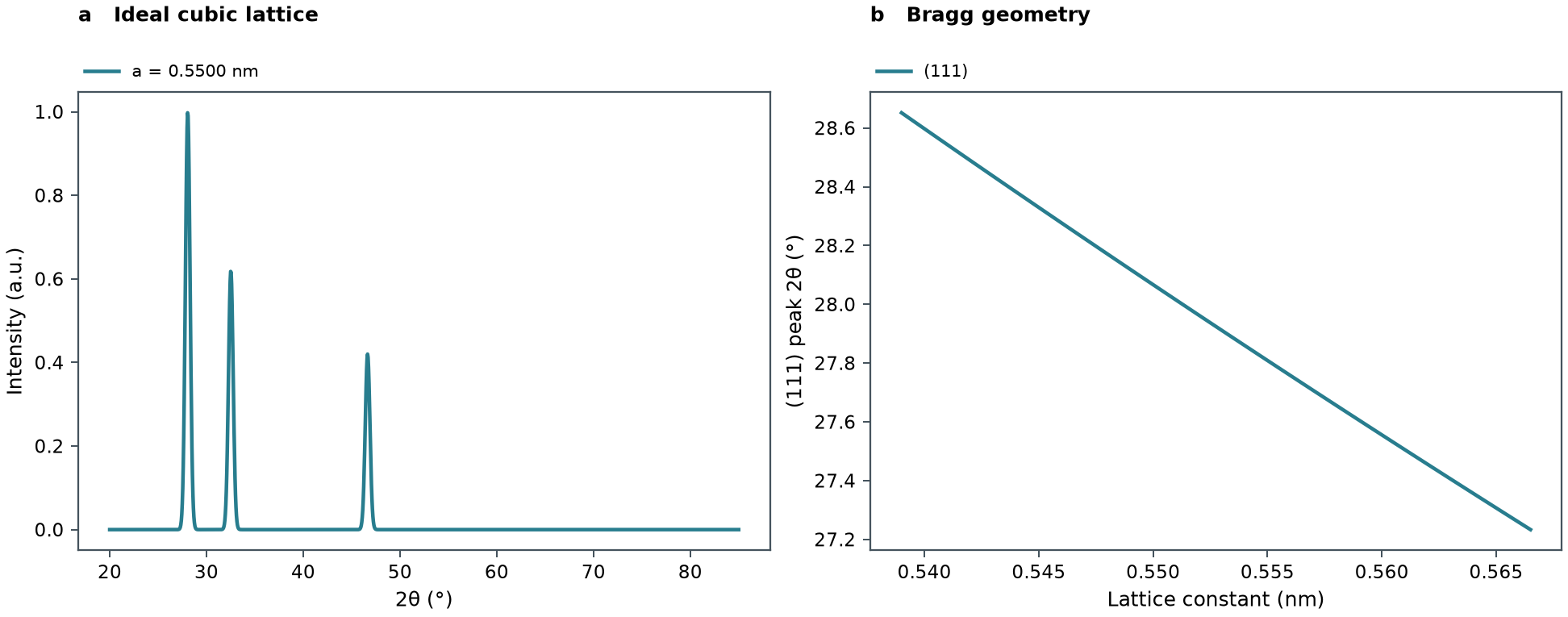
理想立方晶格衍射
论文图型参考 · 原创模型演示。
合成示例 · 非实验数据
 放大图样 ↗
① 源码与 CSV 解压到同一文件夹。
② 请 AI 运行 render_existing.py,得到 PNG、SVG 和 PDF;再核对并换成你的数据。
源码和 CSV 解压到同一文件夹即可重画。图件和提示词可分别下载。
你也可以用自己的话说。
查看请求
请读取绘图包里的 README 和 metadata.json,按说明在项目独立环境中运行包内已有源码,重画这份演示数据。不要重新生成或改写演示 CSV。收到我的文件后,先核对列名、单位、归一化基准与测试条件,再在副本中适配。逐圈容量、库伦效率与容量保持率用散点,不加连线;连续电压和光谱用无点实线,数据坐标四周保留框线。全电池保持率需明确参考圈、参考容量和相同工况,缺项先补齐;Li‖Cu 不强加保持率。不要继承演示条件、补造数据或静默覆盖旧图;回复只给结果位置和必要的下一步。
论文依据、公式与适用范围
原创模型演示,不复现论文数据;图型参考与公式依据分别注明。
Figure 2e–g; Methods: Scherrer crystallite size
d(hkl)=a/sqrt(h²+k²+l²); 2d sinθ=λ
Allowed FCC reflections have all-even or all-odd h,k,l
Hypothetical cubic lattice: a0 is not assigned to Li₂S, Cu or any material. Relative intensities are illustrative, not atomic scattering calculations. Process coordinate is not measured SOC/time.
输入与使用边界
data.csv, model.json
输入格式、单位和条件见 README 与 metadata.json。示例是合成数据,不能用于论文实验结果。
Declared analytic parameters in scientific_basis.parameters; no experimental cell or material is assigned.
示例的模型与依据
按声明的教学模型生成。参数为自设,引用支持公式或测试方法,不是从论文复制的实测数字。
计算关系
- d(hkl)=a/sqrt(h²+k²+l²); 2d sinθ=λ
- Allowed FCC reflections have all-even or all-odd h,k,l
使用边界
- Hypothetical cubic lattice: a0 is not assigned to Li₂S, Cu or any material. Relative intensities are illustrative, not atomic scattering calculations. Process coordinate is not measured SOC/time.
模型来源
- On the nanoscale structural evolution of solid discharge products in lithium-sulfur batteries using operando scattering
Peak evolution / peak-width analysis; instrument and strain contributions must be distinguished.
相关资源
来源与引用
原创合成示例,数据与本版源码包含在绘图包内;未使用论文数据或原图
VoltPeer. 理想立方晶格衍射. Synthetic teaching delivery, version 1.0.0; data generator 1.0.0.BIB ↓ RIS ↓
VoltPeer maintainers · v1.0.0 · MIT
文件、校验与检查状态
文件和格式已检查;模型测试范围见适配说明。格式检查不代表科学审核。
assets/showcase/paper_xrd_fcc/data.csv  fa0e4f31bc4b9a4ac7d82a433cc105397750f246be0fa77a7b17778be9ad61e7
assets/showcase/paper_xrd_fcc/figure.pdf  555504a7661509ea15cfd9d594eae56a8dfdd3e3abc77137ef55a2937eb1829c
assets/showcase/paper_xrd_fcc/figure.png  8dedd34aee6ba873106506f68bc51bcb9e4b847121d7d3be862e69ecece852a0
assets/showcase/paper_xrd_fcc/figure.svg  0d7f407ec6aa676bde92576dbf19a18b920d53bb02ce90ff279b9d2cc47cffbd
assets/showcase/paper_xrd_fcc/metadata.json  b6ba938a541ae44d6d0e24f9b825c8bf6af4eedbd4a1c1f96257c563ddb6b6d0
assets/showcase/paper_xrd_fcc/model.json  10c81a86562f92a9e49bdb84bdca12a3051ca8f8d7445007afc3afa30052eb66
assets/showcase/paper_xrd_fcc/render-report.json  af64247de63dcc384d6bbff5cb194a56b9e89a52311b9eab5adced24464488fd
assets/showcase/BRF-demo-paper_xrd_fcc.zip  91ac18dfb88ed910010ddec0fa39e59dba0776956bf9ed729e47ecfa05156cfa
assets/citations/paper_xrd_fcc.bib  a6a6eb150b4c1c20a8f1e27b130be9c5ea42a243ce42e7a6b29f6fbf0fb3f029
assets/citations/paper_xrd_fcc.ris  f50e3c3549dc7a024a8fff79df1f4e751b817e04a0f794664a7e9ecb334b9709